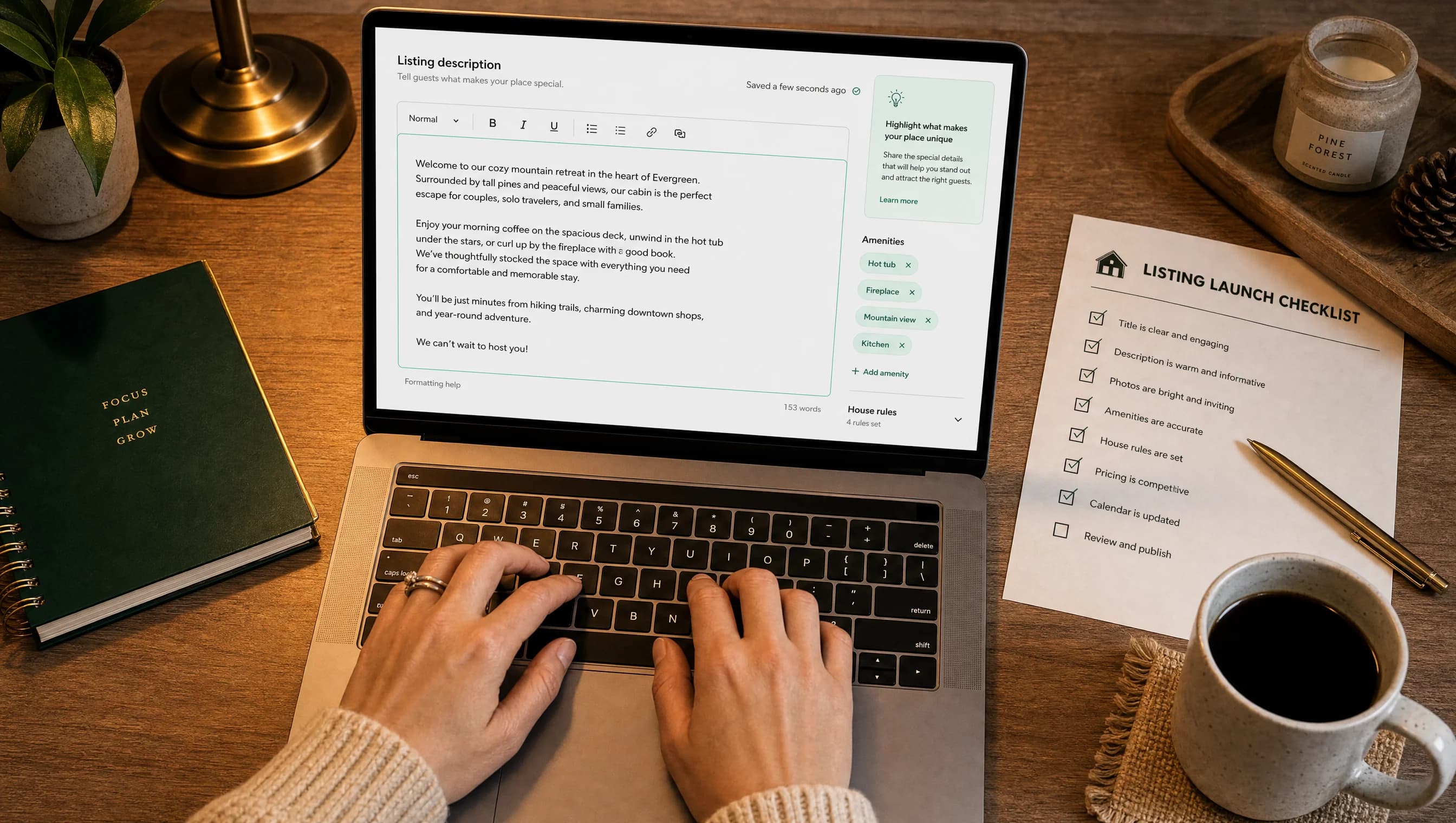
Your listing description has one job: remove doubt.
By the time a guest reads your description, they've already clicked your listing. Your cover photo, title, and price got them in the door. Now they're looking for reasons to book, or more precisely, looking for reasons not to.
The description that converts isn't the one with the most words. It's the one that anticipates every question, addresses every hesitation, and makes the guest feel like they already know what arriving will be like.
Hook
First 200 characters. Vivid, specific opener that captures the feel of the place.
Prove
2-3 short paragraphs on what guests actually love. Pull from your real reviews.
Orient
Practical arrival info. Metro, check-in, quiet hours, wifi speed.
Invite
One warm closing line in first person. Signals a real host behind the listing.
Why most descriptions don't convert↗
Open any 10 Airbnb listings in the same city. You'll notice three patterns:
The inventory list. "This apartment features 2 bedrooms, 1 bathroom, a fully equipped kitchen, WiFi, air conditioning, and a washing machine." This tells the guest nothing they couldn't get from the amenities list. It's redundant information presented boringly.
The hype dump. "You'll LOVE this stunning gem nestled in the heart of the city! An amazing oasis that's perfect for your dream vacation!" This tells the guest that the host has nothing specific to say. Generic superlatives are the enemy of trust.
The wall of text. Eight dense paragraphs with no structure, no bullets, and no visual hierarchy. Even if the content is good, it won't get read. Guests scan. They don't read word by word.
All three patterns share the same problem: they describe the listing from the host's perspective, not the guest's.
The formula: Hook, Prove, Orient, Invite↗
The descriptions that consistently convert follow a four-part structure:
Part 1: Hook (first 2-3 sentences)
The first 200 characters of your description are visible in search previews before guests click "Show more." This is the most valuable real estate in your entire listing.
The hook should name one specific, vivid detail that captures the feel of the place. Not a superlative. Not a generic opener. A concrete detail that makes the guest picture themselves there.
Bad hooks:
- "Welcome to our lovely home in the heart of Barcelona!"
- "This stunning apartment is perfect for your next getaway."
- "Nestled in a charming neighborhood, this cozy retreat..."
Good hooks:
- "You wake up to the sound of church bells and the smell of the bakery downstairs. The balcony catches morning sun until about 11am."
- "The rooftop is the reason guests rebook. Sunset over the old town, a cold drink, and no one else around."
- "This used to be a spice warehouse. The original stone walls and 4-meter ceilings stayed. Everything else got rebuilt last year."
Notice the difference. Good hooks are sensory, specific, and grounded in something real. They make you feel something. Bad hooks are interchangeable between any listing in any city.
Part 2: Prove (2-3 short paragraphs or bullet points)
After the hook, prove your claims. This is where you highlight your 2-3 genuine strengths, backed by what guests actually say in reviews.
Don't invent strengths. Use the ones your reviews confirm. If guests consistently mention the kitchen, the quiet, or the location, those are your proof points.
Structure this section as scannable bullets or short paragraphs:
Example:
- The quiet factor. 15 minutes from the medina on foot, but you return to silence each evening. Guests call it "the best of both worlds."
- The kitchen works. Full-size fridge, gas stove, French press, and enough utensils to actually cook. Not a kitchenette with a microwave.
- Parking included. Free, on-premises, fits any car. In this city, that matters.
Each bullet should name the benefit, then prove it with a specific detail. Not "great location" but "10-minute walk to the main square, 3-minute walk to the L2 bus stop."
Part 3: Orient (1-2 short paragraphs)
This is the most underused section. It answers the question every guest has but rarely asks: "What will arriving actually be like?"
Arrival anxiety is one of the top reasons guests hesitate to book. They're imagining themselves pulling up to a strange address in a foreign city, trying to find the entrance, struggling with a lockbox code.
Your description should pre-answer this:
Example: "The house is on a residential street in the Al Kawthar neighborhood. Taxi drivers know it as 'Al Fakhara.' From the airport, it's a 20-minute drive. The entrance is the blue door next to the corner shop. You'll get a door code and a photo of the entrance 24 hours before you arrive."
This single paragraph does more for conversion than three paragraphs of amenity lists. It removes the biggest psychological barrier to booking: the fear of the unknown.
Part 4: Invite (1-2 sentences)
Close with something that feels like a personal note, not a sales pitch. The best closings make the guest feel like they're being welcomed by a person, not processed by a booking engine.
Good closings:
- "If you have any questions about the neighborhood or need restaurant recommendations, just ask. I've lived here for 12 years."
- "I'm around if you need anything, but I also respect your privacy. You won't see me unless you want to."
Bad closings:
- "Book now before it's too late!"
- "Don't miss this amazing opportunity!"
- "You won't regret it!"
The words to ban from your description↗
These words appear in thousands of listings. They mean nothing. They waste characters. Remove them:
| Banned word | Why | Replace with |
|---|---|---|
| Stunning | Overused, subjective | Name what makes it good: "floor-to-ceiling windows facing the valley" |
| Nestled | Nobody talks like this | Name the actual location relationship |
| Perfect for | Presumptuous, generic | Let the guest decide what it's perfect for |
| Cozy oasis | Two cliches in one | Describe the actual space and feeling |
| Don't miss | Pressure tactic | Not needed if the listing is good |
| Amazing | See "stunning" | Be specific about what's good |
| Unique experience | If you have to say it's unique, it probably isn't | Describe what's actually different |
| Home away from home | The most overused phrase in hospitality | Anything else |
The rule: if you could copy-paste the sentence into any listing in any city and it would still make sense, it's too generic. Delete it and replace it with something only true about your place.
Length and formatting↗
Ideal length: 220-380 words. Enough to cover all four sections. Short enough that guests actually read it.
Format for scanning: Use short paragraphs (2-3 sentences max), bullet points for features, and natural section breaks. Guests read on phones. A 500-word paragraph is a wall on a 6-inch screen.
First-person vs. third-person: First person ("I" or "we") converts better than third person ("The host provides..."). It signals that a real person manages this place and cares about the experience.
Practical details that reduce friction:
- How far from the airport/station
- What the check-in process is
- Whether parking is available
- What the neighborhood feels like
- Any honest limitations ("third floor, no elevator" is better than letting guests discover it)
The description audit checklist↗
Before you publish, run through this:
- Does the first sentence contain a specific, vivid detail (not a superlative)?
- Do my proof points match what guests actually praise in reviews?
- Is there an orientation section that answers "What will arriving be like?"
- Is the closing personal, not pushy?
- Have I removed all banned words?
- Is every paragraph 3 sentences or fewer?
- Would a guest on a phone be able to scan this in 30 seconds?
- Am I honest about any drawbacks (stairs, distance, noise)?
If you check all eight, your description is in the top 10% of listings.
Want a description written for you? Listrino analyzes your reviews and listing data, then generates an optimized description that highlights your real strengths and addresses friction points honestly. It also suggests a title that matches. Your first report is free.