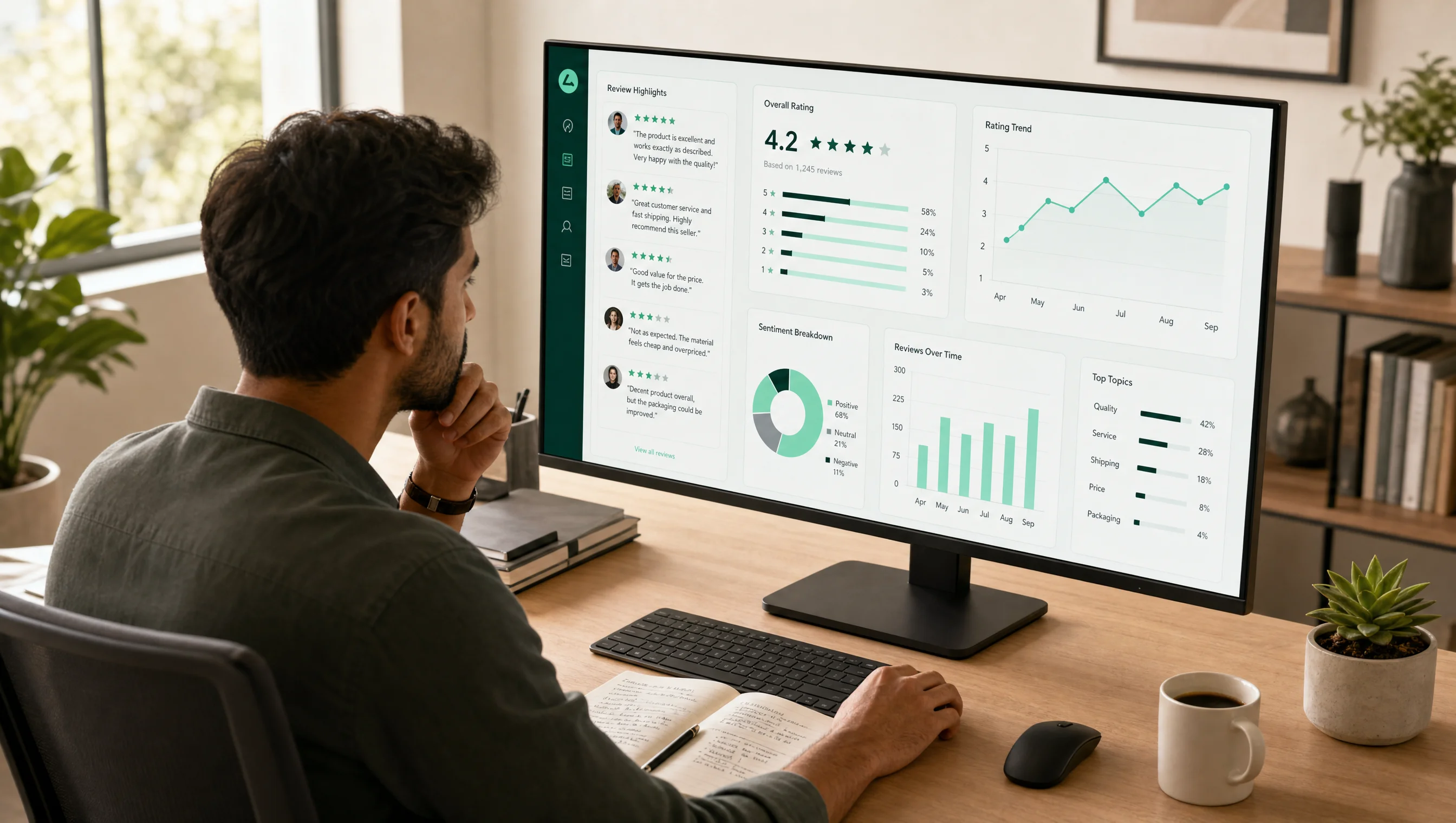
A revenue consultant looking at your Airbnb listing would spend about 60 seconds on your photos and description. They'd spend 30 minutes on your reviews.
That's because your reviews contain something your listing doesn't: ground truth. Not what you think guests experience, but what they actually experience. Not what you think matters, but what guests voluntarily chose to write about.
Most hosts scan their reviews for star counts and move on. Revenue consultants read them for patterns. Here's the system they use, and how you can apply it yourself.
The mindset shift
Your reviews are not feedback. They're structured data that reveals which ranking signals are broken.
The difference between reading and analyzing↗
Reading a review looks like this: "Oh, they liked it. Good." Or: "They complained about the noise. That's annoying."
Analyzing a review looks like this: "This is the fourth guest in six months who mentioned noise. It appears in 20% of reviews. It's costing me 0.2 stars in my Location subcategory. That subcategory is now at 4.4, which is below the algorithm's 4.6 baseline. This is an active ranking penalty."
The first is emotional. The second is operational. Revenue consultants work with the second.
Step 1: Build your frequency table↗
Open a spreadsheet. Read your last 20-30 reviews. For every specific thing a guest mentions, add a tally. Not categories. Specific nouns.
What you're tracking:
| Theme | Positive | Negative | Total |
|---|---|---|---|
| Location / walkability | 12 | 2 | 14 |
| Host communication | 9 | 1 | 10 |
| Cleanliness | 7 | 3 | 10 |
| Noise | 0 | 5 | 5 |
| Check-in process | 2 | 4 | 6 |
| Kitchen | 4 | 0 | 4 |
| Bed comfort | 3 | 2 | 5 |
| WiFi | 0 | 3 | 3 |
| Parking | 4 | 0 | 4 |
| Value for money | 6 | 0 | 6 |
This table is the single most valuable document about your listing. It tells you, in guest-weighted terms, what matters and what's broken.
Step 2: Separate the signals from the noise↗
Not everything in your frequency table is actionable. You need to apply three filters:
Frequency filter: A theme mentioned once is an anecdote. A theme mentioned 3+ times is a signal. Focus on signals.
Severity filter: Some themes have outsized impact. Safety concerns (even one mention) are critical. Cleanliness issues are high-impact because they directly affect subcategory scores. Aesthetic preferences are low-impact.
Controllability filter: You can fix WiFi speed. You can't move your listing closer to the city center. Focus on things you can actually change.
After applying these filters, your 15-row table usually narrows to 5-7 themes that are both frequent enough to matter and within your control to address.
Step 3: Map themes to the three action categories↗
Every theme in your filtered table maps to one of three categories:
Fix: Themes with negative mentions that recur
These are active liabilities. Every negative mention in this category is costing you stars, reducing your subcategory scores, and pushing you down in search.
Examples:
- "Check-in was confusing" (3 mentions) -> Rewrite check-in instructions, add photos of the entrance
- "WiFi was slow" (3 mentions) -> Upgrade router or add a mesh extender
- "Pillows were uncomfortable" (2 mentions) -> Replace pillows, mention "new premium pillows" in the listing update
The rule of thumb: if 2+ guests mention the same negative thing, it's a structural problem, not a guest preference issue.
Leverage: Themes with positive mentions that aren't reflected in your listing
These are hidden strengths. Guests love them, but your title, photos, and description don't feature them.
Examples:
- "The natural light was incredible" (8 mentions) -> Shoot new photos in morning light, add "sun-filled" to your title
- "So quiet for this neighborhood" (5 mentions) -> Lead your description with the quiet factor, address location doubts proactively
- "The kitchen was fully stocked" (4 mentions) -> Add a kitchen photo to your top 5, mention specific equipment in the description
The leverage move is making your listing sell the things guests already love. Most hosts undersell their genuine strengths because they've become invisible through familiarity.
Steal: Themes from competitor reviews that don't appear in yours
This requires reading reviews on the top 3-5 listings in your area. Look for themes that guests praise in those listings but never mention in yours.
Examples:
- Competitors' guests rave about "the welcome guide" -> Create a local tips document
- Competitors' guests mention "self check-in was seamless" -> Install a smart lock
- Competitors' guests love "the coffee station" -> Add a quality coffee setup and photograph it
Step 4: Prioritize by impact↗
You now have a list of Fix, Leverage, and Steal items. But you can't do everything at once. Prioritize:
Critical (do this week):
- Safety or compliance issues (missing smoke alarm, guest boundary concerns)
- Any subcategory score below 4.3
- Any negative theme mentioned in 4+ recent reviews
High (do this month):
- Negative themes mentioned in 2-3 reviews
- Subcategory scores between 4.3 and 4.6
- Your top 2 leverage items (biggest gap between guest praise and listing visibility)
Medium (do next month):
- Single-mention negatives that are easy to fix
- Remaining leverage items
- Steal items from competitor analysis
What consultants look for that most hosts miss↗
The "silent 4-star" problem
Some guests give you 4 stars without explaining why. If your overall average is below 4.8 but your written reviews are mostly positive, the gap is coming from guests who are quietly disappointed about something they don't bother to articulate.
The most common cause: a mismatch between listing photos and reality. The apartment looks bigger in photos. The "city view" is partially blocked. The "quiet street" has morning delivery trucks.
The fix is radical honesty in your listing. Guests who book with accurate expectations leave 5 stars. Guests who arrive to a surprise leave 4 stars. Every time.
The vague review trap
Reviews like "Nice place!" or "Good stay, thanks" are worthless for analysis. But their existence tells you something: these guests didn't have a strong enough experience to write about it.
That's a leverage problem. If your listing is functional but unremarkable, you'll get bookings but you won't get the 5-star momentum that compounds into higher rankings. Adding one memorable element (a welcome note, a curated guidebook, a small local gift) often turns "Nice place" into a paragraph of praise.
Review response as a conversion tool
Your responses to reviews aren't just for the guest who wrote them. They're for every future guest who reads the review thread before booking.
A defensive response to criticism ("Sorry you felt that way, most guests love it") signals that the problem will still be there. A constructive response ("Thank you for this feedback. We've upgraded the WiFi router and added a mesh extender") signals that you listen and improve. That signal converts skeptical browsers into confident bookers.
A real consultant engagement in 5 minutes↗
Here's what the process looks like on a real listing:
Listing: 1-bedroom apartment in Lisbon, 4.65 overall, 47 reviews
Frequency table (top themes from 30 most recent reviews):
- Location praised: 14 mentions
- Host responsive: 9 mentions
- Noise complaint: 5 mentions
- Check-in confusion: 4 mentions
- "Great value": 6 mentions
- "Beautiful light": 8 mentions
- WiFi issues: 3 mentions
Action plan:
- Fix: Noise (5 mentions) -> Add "quiet hours" to house rules, provide earplugs, mention "residential neighborhood" in description honestly
- Fix: Check-in (4 mentions) -> Rewrite instructions with photos of the exact entrance and door
- Fix: WiFi (3 mentions) -> Upgrade to fiber or add mesh network
- Leverage: Beautiful light (8 mentions, not in photos or title) -> Reshoot cover photo in morning light, add "sun-filled" to title
- Leverage: Location (14 mentions, generic in current description) -> Rewrite opening to name specific landmarks within walking distance
- Steal: Top competitor offers a printed walking guide -> Create a neighborhood PDF
Time to produce this plan: about 30 minutes of focused review reading. Expected impact: 0.2-0.3 star improvement within 8-12 weeks, which translates to measurably higher search position.
This is exactly what Listrino automates. Paste your listing URL, and Listrino reads every review, builds the frequency table, maps themes to Fix/Leverage/Steal, benchmarks you against top competitors, and delivers a prioritized action plan. It also suggests an optimized title and description based on what your reviews reveal. Your first report is free.